

✏️ Beyond the Essay: The Multi-Purpose Script (+ TEMPLATES)
How can students write as deep as possible with as few words as possible? Why not try invented dialogue?

I wrote the following post in April 2025—Three complete drafts, apparently!—and then procrastinated about publishing until I just plain forgot. You know, this might be my biggest flaw in blogging: For every post I publish, I probably wrote at least four others. This post stitches together drafts with minimal revision. I would love to expand on this topic, so nudge me with questions in the comment section!
The Problem. Days into writing essays, despite time spent developing ideas, many students hit brick walls with underdeveloped ideas. Their essays are short and shallow. How can students explore ideas as deep as possible with as few words as possible?
Questions. What if students wrote dialogues exploring topics? Would this allow them to be more direct in analysis (with fewer words) by moving between questions and answers? Would replacing more traditional prewriting with dialogues improve responses?
Aside. I’ve long questioned traditional prewriting. The “BOWR” approach—or brainstorm, outline, write, revise—prevents exploring ideas while writing. It alienates writing within communities. And let’s face it, BOWR practically assumes the final product before writing. For several years I’ve been experimenting with moving away from this failed approach.
Background. We spend the first month of my class exploring writing across mediums—letters, essays, and dialogues. My favorite progression moves from transcribing move clips in play from to integrating quotations.
As activities, James Moffett suggests transcribing speech and invented speech. He likewise suggests transforming ideas across mediums rather than traditional prewriting.
Moving between mediums teachers through contrast. But only writing in one medium—the tested essay—obscures finer details in form and convention.
Invented dialogue relies on question and answer. This connects to question writing (QAR). Students write twenty questions, narrow them down, then connect them to generate the conversation.
Speech Games. Teaching awareness of dialogue takes minutes. I love the following speech game: Students talk naturally in groups, but follow basic rules, each for a minute or two each. Once you progress through each rule, ask which works best.
Rule 1. Speak in statements only.
Rule 2. Speak in questions only.
Rule 3. Speak in a statement followed by a question.
Teaching Dialogue. While teaching dialogue departs from the norm, we should always consider writing as an extension of speech. In the first weeks of school, I love having students transcribe speech. The activity is simple: We watch a movie clip, record what they say, and rewatch for accuracy.
From there, transcription becomes the first step in a progression. With the result in script form, we then practice converting speech into regular prose. This sets the stage for teaching speech-as-evidence, summaries, and analysis (This borrows the framework from They Say, I Say.)
Workflow. Writing dialogue has many correct entrance points. Regardless, I suggest moving from transcribed dialogue to invented dialogue. Observation should follow creation, here. So how do you start? I have several suggestions
1. Complete dialogue. Introduce an incomplete dialogue with only five or six lines of speech. As a class, practice adding to it. Discuss how questions direct conversations.
2. Read student dialogues. As a Year 2 activity, begin a topic with student examples. This not only adds authenticity, but saves time in explanation.
3. Start with questions. Begin with a list of twenty questions about a reading. Then select ten questions and order them as question and follow up question.
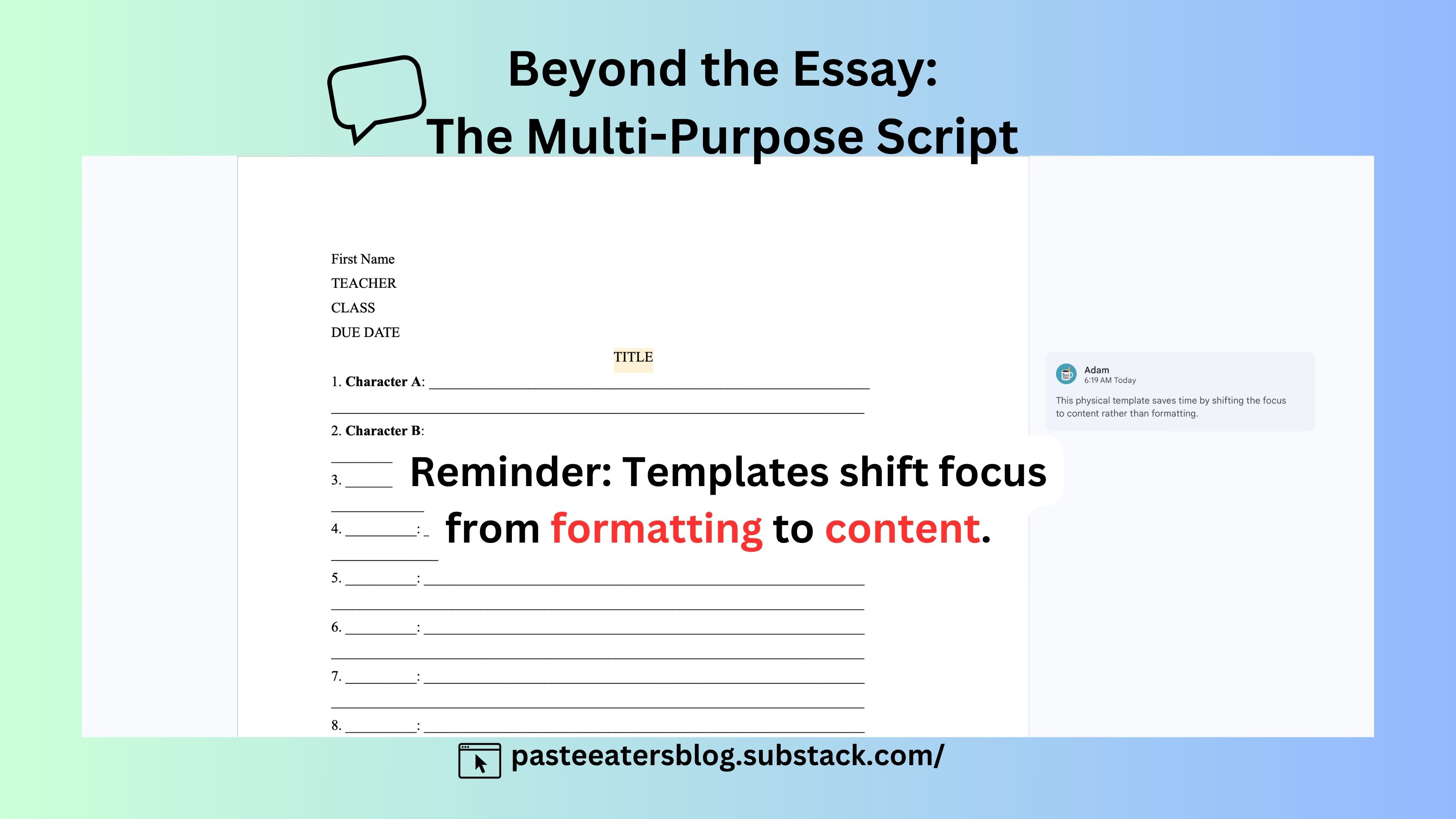
Regardless, I would suggest starting with templates galore, from paper templates (for drafting) to digital templates (for typing). This step drastically increases productivity when it comes to appearance and readability.
Common Issues. Where do students struggle? Beyond expected areas, such as length and conventions, you might expect the following:
1. Writing statements. Some students ignore purpose entirely and write statements only. There’s nothing wrong with constantly adding ideas, but it misses the point.
2. Uniform question types. While I forbid yes/no questions from my 20 Questions assignments, I allow them here. However, watch for all yes/no conversations.
3. General Flow. Some students sequence questions awkwardly, resulting in disjointed conversations.
Yes, but. “Why waste your time writing scripts when The Test demands an essay? Isn’t that a waste of time? Scripts aren’t standards.”
Beware the writing mono-diet. When students write only one way, they think only one way. And tested writing isn’t real writing.
When all writing means five-paragraph essay, everything has an introduction, a body, and a conclusion, which isn’t entirely true.
Moving between mediums teaches through contrast. Transforming conventions helps cement them better than covering one medium alone.
Instead. Essays present barriers for many: in form, style, tone, and so on. Dialogues remove these barriers, opting for natural conversation over formal convention. If I wanted the best analysis with the fewest words possible, scripting conversations helped.
Essay responses improved after trading more traditional prewriting for transforming scripts. They both stand on their own and hold the potential for more.
Recent reflection letters indicated students preferred scripts to essays. This calls for pause and introspection. I’m not anti-essay, but rather pro-widening the available writing.
When moving from scripts to essays, text structure serves as the on-ramp. As defined in Dual Coding for Teachers, the following questions stand out.
Description (Analysis): How would you describe [topic]? List five things about [topic]?
Compare and Contrast: How are these things similar? How are these things different? Which option is better and why?
Chronological: How did this happen? What events led to this?
Cause and Effect: Why did this happen? What factors led to this? Predict what will happen if [event]? What will happen if [event]?
Other Uses. As I’ve experimented with scripting, it’s felt freeing thinking beyond the confines of essay-centered writing. Where else should students script? Five areas stand out:
1. As review. What if students reflected on recent skills by narrating the steps? What if this included questions about where processes fail? Imagine scripting a how to essay.
2. As summaries. What if students broke up regular summarizing by chronicling main events with questions thrown in? In academic writing, summarizing serves as evidence.
3. As analysis. What if students analyzed ideas and literature beyond traditional essay form? What if conversation weaved through basic explanations?
4. As prewriting. What if students abandoned traditional prewriting by scripting a conversation first? What if students transformed the ideas into other mediums (essays)?
5. As literature. What if students struggled with dialogue in narratives because they don’t write it? What if they started stories as dialogue first?
Student Feedback. Recently [Spring 2025], students had to summarize chapter 18 of Mockingjay. When given the choice, many chose to write a dialogue instead. But why? Here’s what students said in an informal survey:
“I chose to write your summary as a dialogue rather than paragraph form because it is easier and is more fun to do.”
“I can explain more with questions to keep me on pace”
“I choose dialogue because it is faster.”
“Explaining the events to someone like I am in a conversation feels like I recall and explain better.”
“Because I thought it would be easier to do, and I like doing those better because you can get your point across and it is like you are just talking to someone in person.”
“I chose to write my summary as a dialogue rather than a paragraph because the formatting made it easy to explain my ideas and I wanted a sort of challenge. Summaries can be boring to write.”
Conclusion. So why not add more variety to your writing diet? Why not explore other means of prewriting? This one might just surprise you!
Resources (Links)
🎁 New to the blog? Check out my recent starter pack as well as a Google Drive Folder with FREE classroom resources! Also, The Honest School Times has your schooling satire.
⏰ Recent Posts
My ICTE Talk 2026 (3/28/2026)
Celebrating the Small Successes (Textbook Rants) (3/26/2026)
HST: Student Maps Out NFL Career (3/20/2026)
My Teach Indy Talk 2026 (3/7/2026)
HST: Student Optimistic Five-Point Quiz Will Boost Grade (3/4/2026)
HST: Local Student Claims She Will Do Work “At Home” (2/28/2026)
10 Fantastic Books for Teaching Writing (2/14/2026)
How to Write Useful Sub Notes (2/1/2026)
Teaching Writing through Transformation (James Moffett on Invention) (1/17/2026)
Why Traditional Prewriting Fails (1/11/2026)
English Has No Super-Structure (James Moffett on English Curriculum) (12/31/2025)
Where AI Fails Analogy Questions (12/28/2025)
Getting Difficult Students to Write (and Other Topics) (12/13/2025)
Where Traditional Writing Instruction Fails (11/28/2025)
My AMLE25 Talk (“Help! I don’t know how to teach writing!”) (11/15/2025)
How to Teach Writing Without Curriculum (1.0) (11/3/2025)
10 Myths about Teaching Writing (10/19/2025)
50 MORE Metaphorical Writing Prompts (10/5/2025)
The Art of the Reading Guide (9/27/2025)
Teach Computer Literacy Before AI (9/13/2025)
The Mysterious Disappearing Analogy Book (9/7/2025)
Templates for Teaching Quotations (8/30/2025)
The Joy of Teaching Siblings (8/24/2025)
How Google Forms Simplifies Data Collection (8/10/2025)
Back to School Night (8/3/2025)
33 Big Ideas to Start Your School Year (7/23/2025)
Teach Computers Before AI: A Sketch (7/21/2025)
Creative Writing Doesn’t Exist (7/17/2025)
How to Teach with Student Writing (6/25/2025)
Practice Writing Rules by Breaking Them (6/21/2025)
🏆 Fan Favorites
This is great for so many reasons. First, I love writing, but if you make me do an outline first I am never getting there (P.S. to every teacher I ever submitted an outline to...I wrote it after the essay!). And how many times before you write something do you talk it out with someone, even if it is just yourself in the car? And finally, does it matter what path I take to get to my well thought out essay that shows my learning? I say no. Connects a bit to my post today about compliance vs. learning.